
Few questions about AI generate more anxiety than “will it take my job?” The honest answer is that nobody knows exactly, but a growing body of research gives a clearer picture than the headlines suggest. The main pattern so far: AI changes the tasks inside jobs faster than it removes jobs entirely, and the effects are uneven across occupations, countries and career stages.
Key takeaways
- AI is changing the tasks inside jobs faster than it is removing whole jobs, and the effects vary by occupation, country and career stage.
- The IMF estimated in 2024 that around 40% of jobs worldwide are exposed to AI, rising to about 60% in advanced economies.
- In a study of more than 5,000 support agents, an AI assistant raised issues resolved per hour by about 14%, with the biggest gains for the least experienced.
- To prepare, map your own tasks, get good at checking AI output, and invest in skills AI does poorly, such as relationships and judgment.
Think in tasks, not jobs
Most jobs are bundles of tasks. A paralegal researches case law, drafts documents, manages files, talks to clients and coordinates deadlines. Generative AI is good at some of those tasks, such as summarizing documents and producing first drafts, and weak at others, such as building trust with a nervous client.
That is why economists measure exposure: the share of a job’s tasks that AI could plausibly speed up or perform. Exposure is not the same as replacement. A highly exposed job may become more productive, change shape, or shrink, depending on how employers use the technology and how much demand there is for the work.
Who is most exposed
Several large studies point in the same direction:

- The International Monetary Fund estimated in 2024 that around 40% of jobs worldwide are exposed to AI, rising to about 60% in advanced economies, because those economies have more cognitive, office-based work.
- The International Labour Organization has found that clerical and administrative roles are the most exposed occupational group, and that for most other jobs AI is more likely to change tasks than to automate the whole role.
- The World Economic Forum’s Future of Jobs Report 2025, based on surveys of large employers, projected both substantial job creation and displacement by 2030 across all technological and economic trends, with the net effect positive overall but with major shifts in required skills.
In contrast to earlier waves of automation, which mostly affected routine manual work, generative AI is most relevant to well-paid, educated office work: writing, analysis, coding, customer support and design.
Where AI is helping workers
The clearest evidence of benefit comes from studies inside real workplaces:
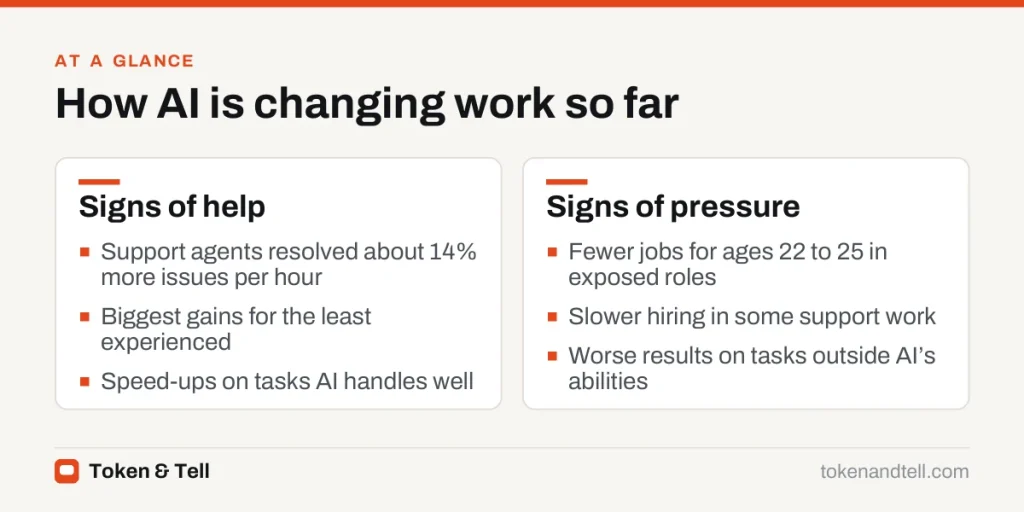
- A study of more than 5,000 customer support agents, published by economists from Stanford and MIT, found that access to an AI assistant raised the number of issues resolved per hour by about 14% on average, with the largest gains, around a third, for the least experienced agents.
- Experiments with consultants, writers and programmers have found similar patterns: meaningful speed-ups on tasks the AI handles well, and worse results when people rely on it for tasks outside its abilities.
That second finding matters. AI tends to raise the floor for less experienced workers on suitable tasks, but it can also lead to confident mistakes when used carelessly. Knowing where the tool is reliable is itself becoming a job skill.
Early signs of disruption
There are also signs of pressure, particularly at the start of careers:
- Research from Stanford’s Digital Economy Lab using payroll data found that, from late 2022 to mid-2025, employment for workers aged 22 to 25 fell noticeably in the occupations most exposed to AI, such as software development and customer service, while older workers in the same fields were less affected.
- Some companies have said they are slowing hiring in roles where AI now handles part of the workload, particularly in customer support and routine content production.
It is still early, and these trends overlap with other factors such as interest rates and post-pandemic corrections in tech hiring. But the concern that AI could narrow the entry-level jobs where people traditionally learn their trade deserves attention.
Entry-level work is often where people build the judgment that makes senior workers valuable. If AI absorbs those tasks, employers will need new ways to train people, and workers will need to find them.
New work is appearing too
New technology also creates tasks. AI has increased demand for people who can build, evaluate and maintain AI systems, check and edit AI output, manage data, and redesign workflows around new tools. Many existing roles are also absorbing AI-related responsibilities, such as prompt design in marketing or AI review in legal work, rather than spinning them into new job titles.
How to prepare
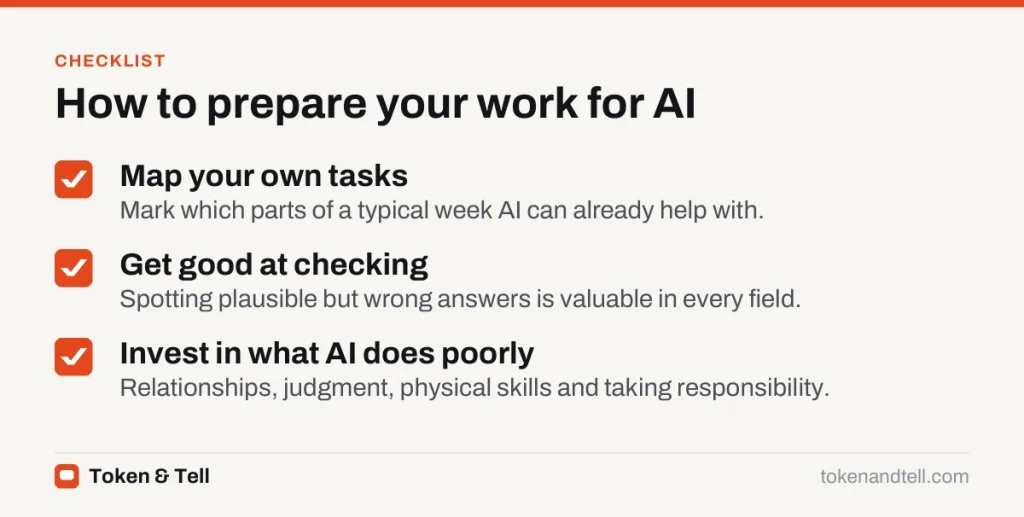
Whatever your role, start by mapping your own tasks. List what you do in a typical week, mark the parts AI can already help with, and start using it there. Get good at checking its work, because spotting a plausible but wrong AI answer is valuable in almost every field.
It also makes sense to invest in what AI does poorly: relationships, judgment under uncertainty, physical skills and taking responsibility for decisions are still hard to automate. Share what works with colleagues, since people who help their teams adopt AI well are hard to replace. And watch your own industry rather than the headlines. The effects vary enormously by sector.
For job seekers, our guide to how AI is changing job hunting covers the hiring side.
Frequently asked questions
Will AI take my job?
So far AI is changing the tasks inside jobs faster than it removes whole jobs, and the effects differ by occupation, country and career stage. Exposure to AI is not the same as replacement.
Which jobs are most exposed to AI?
Clerical and administrative roles are the most exposed group, and generative AI is most relevant to office work such as writing, analysis, coding, customer support and design.
Is AI affecting entry-level jobs?
Research using payroll data found employment for workers aged 22 to 25 fell noticeably in the most AI-exposed occupations from late 2022 to mid-2025, though other factors such as interest rates also played a part.
What skills will stay valuable as AI spreads?
Checking AI output, building relationships, making judgments under uncertainty, physical skills and taking responsibility for decisions remain hard to automate.
Sources
- AI Will Transform the Global Economy. Let’s Make Sure It Benefits Humanity, IMF, January 2024
- The Future of Jobs Report 2025, World Economic Forum
- Generative AI at Work, Brynjolfsson, Li and Raymond, National Bureau of Economic Research
- Canaries in the Coal Mine? Six Facts about the Recent Employment Effects of Artificial Intelligence, Stanford Digital Economy Lab, 2025
- Generative AI and Jobs: A Refined Global Index of Occupational Exposure, International Labour Organization, 2025