
AI can transcribe a lecture, summarize a chapter and turn a messy page of notes into a tidy outline in seconds. That is useful. It also creates a trap: notes you did not think about are notes you will not remember.
Key takeaways
- Write brief notes in your own words during a lecture or reading, because summarizing as you go helps you learn.
- After the session, ask an AI assistant to compare your notes with the transcript or source and list the important points you missed.
- Add those gaps to your notes in your own words, since rewriting is the step that matters most for learning.
- Use AI to quiz you with questions and flashcards from your notes, and check important summary details against the original source.
Research on learning consistently finds that the effort of processing information, putting ideas in your own words, connecting them and testing yourself, is what makes it stick. The goal is to use AI to remove the busywork of note-taking while keeping the thinking. Here is a method that does that.
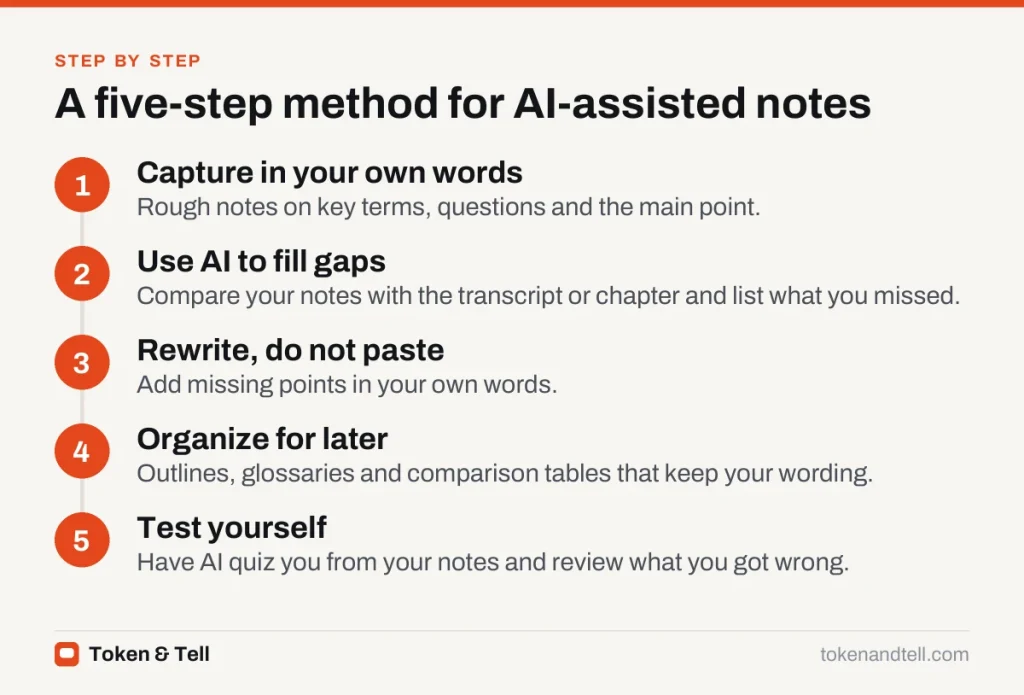
Step 1: Capture in your own words first
During a lecture or while reading, keep writing brief notes yourself: key terms, questions, anything that surprises you, and what you think the main point is. They can be rough. A well-known 2014 study by Mueller and Oppenheimer found that students who took notes by hand tended to process ideas more deeply than those who typed lectures nearly word for word. Later studies have questioned how large the effect is, but the underlying lesson holds: summarizing as you go helps you learn.
If you are allowed to record the lecture, do so as a backup, but do not let the recording replace your attention. Always check your institution’s rules and ask permission before recording.
Step 2: Use AI to fill gaps, not to start from zero
After the session, bring your rough notes and the source material together. With a recording, transcribe the audio, then ask an AI assistant to compare the transcript with your notes and list the important points you missed. With a book or article, paste a chapter or upload a PDF you have the right to use, ask for the main arguments and compare them with what you wrote. Many tools can also pull a transcript from a video, which you can treat the same way.
A useful prompt:
A prompt for this might read: “Here are my notes from a lecture on supply and demand, followed by the transcript. List the five most important ideas from the lecture. For each, say whether my notes already cover it, partly cover it or miss it. Quote the transcript for anything I missed.”
Asking for quotes from the source makes it easier to catch mistakes, because you can check the quote exists.
Step 3: Rewrite, do not just paste
Take the AI’s list of gaps and add them to your notes in your own words. This is the step that matters most for learning, and the one most tempting to skip. If you cannot explain a point in your own words, that is a sign you need to reread it or ask about it.

Step 4: Organize for later
Once the notes are yours, AI is good at structure:
- Turn notes into an outline with headings
- Group related ideas from different lectures
- Create a glossary of terms with short definitions
- Draw a simple table comparing theories, methods or examples
Ask it to keep your wording where possible, so the notes stay recognizably yours.
Step 5: Test yourself
The best use of AI for studying is not summarizing but quizzing. Ask it to write questions from your notes, answer them without looking, then check. Techniques such as retrieval practice and spaced repetition have strong research support, and AI makes them easy to set up:
- “Write ten short-answer questions from these notes, mixing easy and hard.”
- “Ask me one question at a time and tell me what I got wrong.”
- “Turn these notes into flashcards with a question on one side and a one-sentence answer on the other.”
What to watch out for
AI summaries can leave out qualifications, merge separate ideas or state something the source never said, so check anything important against the original. Our guide to summarizing documents with AI covers how.
Using AI to organize your own notes is usually fine, but submitting AI-written work as your own often isn’t, so check your course policies. And don’t upload textbooks or lecture recordings to tools where you’re not allowed to, or share recordings that include classmates’ voices without their consent.
A quick routine
| When | What to do | Time |
|---|---|---|
| During the lecture or reading | Rough notes in your own words | As long as it takes |
| Same day | AI gap check against the source, rewrite missing points | 15 minutes |
| End of week | AI turns notes into an outline and a set of questions | 10 minutes |
| Before the exam | AI quizzes you; review what you got wrong | Regularly |
Frequently asked questions
Should I let AI take my notes for me?
Use it to fill gaps and organize, not to replace your own notes. Research on learning finds that putting ideas in your own words and testing yourself is what makes them stick.
Can I record lectures and transcribe them with AI?
Often, but check your institution's rules and ask permission first, and avoid sharing recordings that include classmates' voices without consent.
What is the best way to study with AI?
Quizzing beats summarizing. Ask the AI to write questions from your notes, answer them without looking, and use flashcards for spaced repetition.
Is using AI for notes against academic rules?
Using AI to organize your own notes is usually fine, but submitting AI-written work as your own often is not, so check your course policies.
Sources
- The Pen Is Mightier Than the Keyboard: Advantages of Longhand Over Laptop Note Taking, Mueller and Oppenheimer, Psychological Science, 2014
- Improving Students’ Learning With Effective Learning Techniques, Dunlosky et al., Psychological Science in the Public Interest, 2013
- Retrieval practice, RetrievalPractice.org